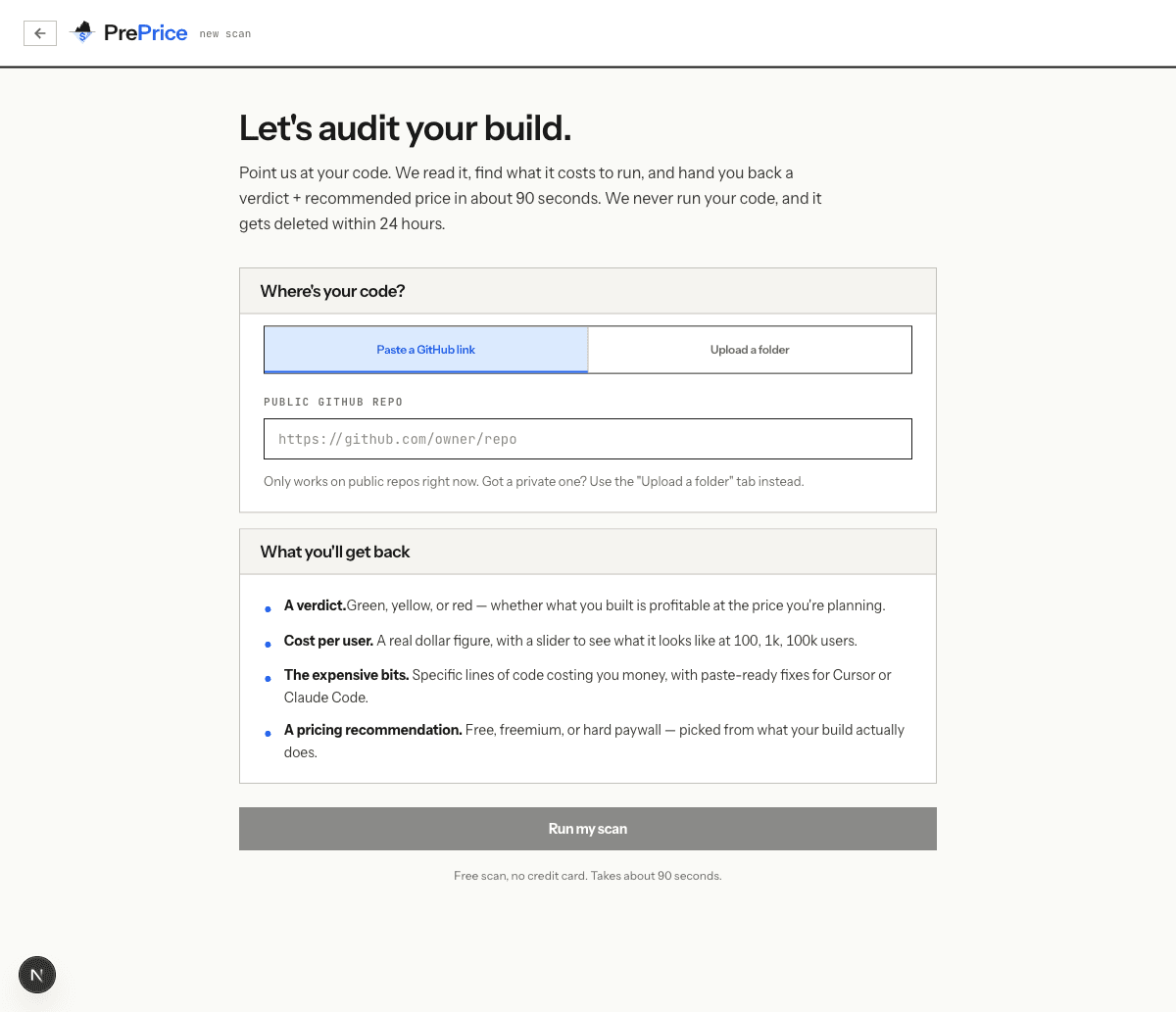
Point PrePrice at your project. In a couple of minutes you get a clear verdict: what it costs to run, what to charge for it, and which parts of your code are quietly eating your margin. Cut today's bill. Ship something that stays cheap as it scales.
Free tier · No credit card · GitHub URL or zip upload
“I accidentally burned ~$0 of Claude usage overnight with one command.”
That is the actual title of a real Reddit post. A developer left one /loop command running unattended on Opus 4.7. 46 iterations later, 26 hours later, ~$6,000 gone before the invoice email even arrived. u/procrastinator_eng on r/ClaudeAI, Apr 2026. Bills like this happen because nobody runs the math before they ship. PrePrice runs it for you in a couple of minutes, so the next surprise bill is the one you saw coming.
We track pricing across 100+ services so you don't have to read every vendor's page.
Every service in your stack has its own pricing page. Free tier, paid tier, usage tier. Per-request, per-seat, per-event, per-gigabyte. Some meter bandwidth. Some meter active rows. Some charge for the seat and then again for the run. The same number on two vendor pages can mean two completely different things.
Working out what your specific build will actually cost means opening 20 tabs, reading the fine print on each one, and stitching it together yourself. Most builders do not bother. They guess, ship, and find out in the invoice.
We do the math for you. Three questions your audit will answer:
Most vibe-coded apps are not. The gap is usually wider than founders expect.
Most of it is one or two lines of code you forgot to cache, or a retry loop that tripled your bill.
You scaled to that number in your head. Whether your stack did is a different question.
80 seconds, end to end. Drop in a repo, watch the verdict, the stack, the cost projection, and the file-by-file fixes come back.
Connect your project and walk away with the math. It would otherwise take a week of spreadsheets and pricing pages to assemble it yourself.
GitHub link or zip upload. SaaS app, agent, agentic flow, weekend side project. It does not matter what you built. We pull out the cost-relevant parts and skip the rest. We never run your code. Your source is wiped seconds after we read it, never written to our database, never embedded, never copied. Every report ships with a cryptographic receipt so you can verify exactly that.


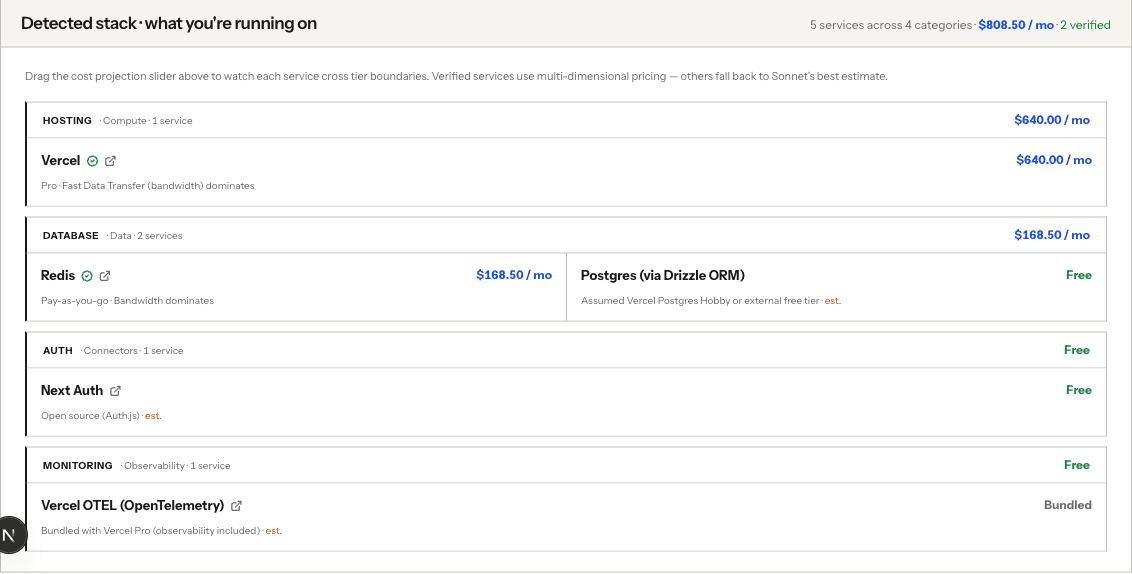
Our catalog covers 100+ services: Vercel, Supabase, Stripe, Anthropic, OpenAI, ElevenLabs, Pinecone, and 90 more. For each one we map what your code actually uses, show you the live tier, and link back to the vendor's page so you can verify every number.
The slider sweeps from 100 users to a million, and every service in your stack reacts in real time. Verified vendors use their real multi-dimensional pricing (bandwidth, storage, requests), so you see exactly where each tier ladder bites.
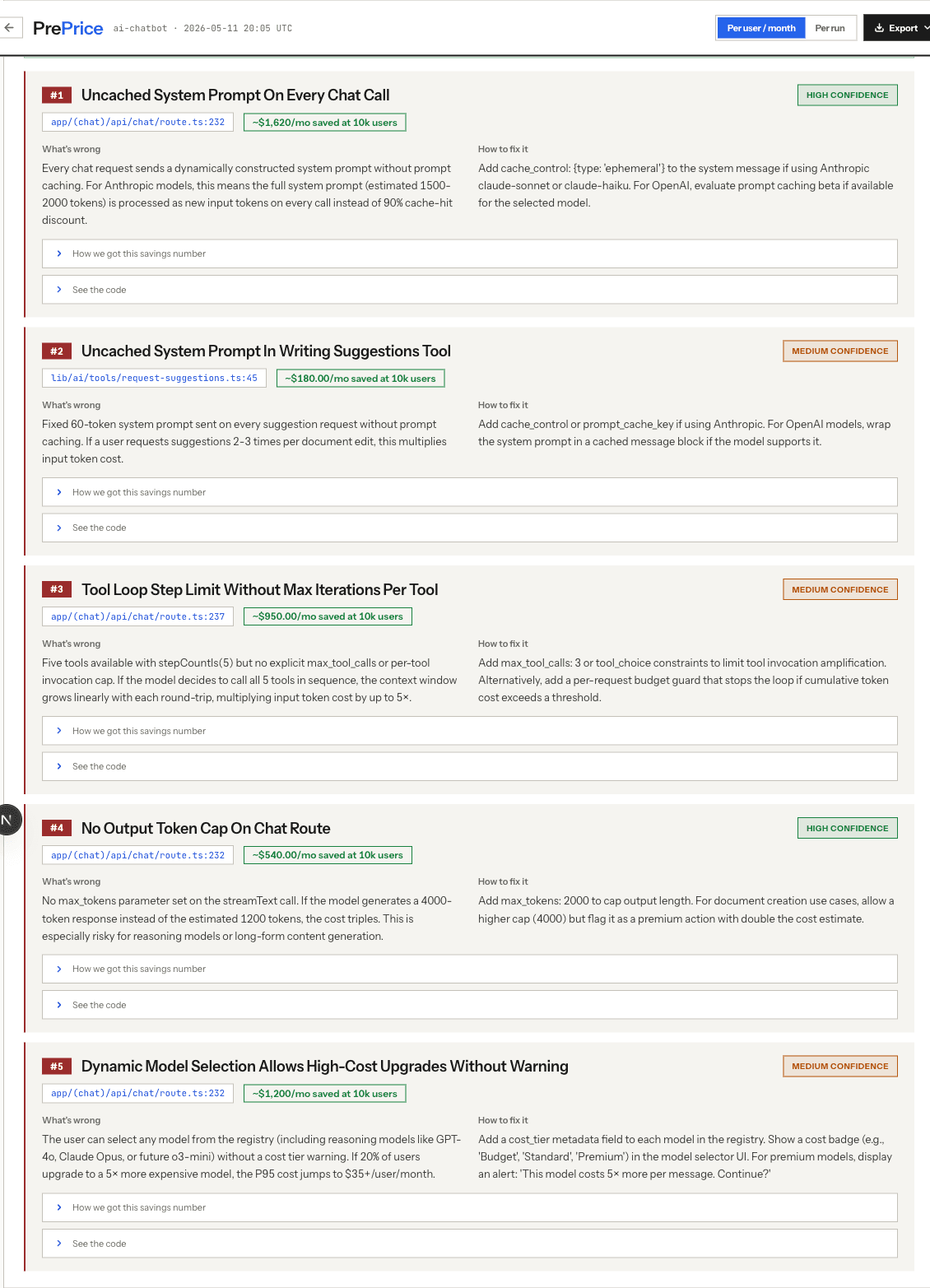
For every cost driver we surface: file path, line number, what's wrong, the fix, and what it saves you at 1k and 10k users. Copy the whole list as a single prompt and paste it straight into Cursor or Claude Code. We do the diagnosis. You keep the credit.
PrePrice was designed so your source code never lives anywhere we control for longer than it takes to read it. The numbers below describe what actually happens, not aspirational policy.
GitHub: we shallow-clone into an ephemeral worker disk that gets rmtree'd the moment your scan finishes, success or failure. Zip uploads:the object is deleted from our storage the second we finish unzipping it. Both timestamps appear on every report's receipt.
Your source bytes never reach Postgres. Only the structured audit (cost drivers, vendor links, fix recommendations) is persisted. Enforced by an RLS policy named in the receipt. There is no row in any table that contains your code.
Each report ships with a SHA-256 of the exact archive (or repo HEAD commit) we analyzed. Re-hash your local copy with shasum -a 256 or git rev-parse HEAD and confirm we analyzed what you sent. No third-party audit needed.
Before any analysis runs we delete every .env, credentials file, SSH key, and auth token from the worker disk. We detect your stack from package.json, imports, and hosting config instead. The receipt lists exactly what was scrubbed.
Every number in your audit comes from a real plan on a real vendor page. Parallel AI agents scrape each pricing page and cross-check the results, an automated quality pass validates every number against the source, and a human reviewer reads the diff and signs off before the row enters the engine. Each entry is stamped with a verification date so you can see how fresh the number is. The catalog spans LLMs, hosting, payments, voice, vector databases, auth, monitoring, and analytics, with every plan and pricing dimension modeled, not just a single sticker price.
| Provider · Plan | Dimension | Unit | Price |
|---|---|---|---|
AnthropicLLMClaude Sonnet 4.6 | 5 pricing dimensions modeled | ||
| Input tokens | per 1M | $3.00 | |
| Output tokens | per 1M | $15.00 | |
| Cached input read | per 1M | $0.30 | |
| + 2 more dimensions in this plan | |||
VercelHostingPro | 6 pricing dimensions modeled | ||
| Seat | per month | $20.00 | |
| Bandwidth (over 1 TB) | per GB | $0.15 | |
| Function execution | per GB-hr | $0.18 | |
| + 3 more dimensions in this plan | |||
OpenAILLMGPT-4o | 4 pricing dimensions modeled | ||
SupabaseDatabasePro | 5 pricing dimensions modeled | ||
StripePaymentsStandard | 5 pricing dimensions modeled | ||
ElevenLabsVoiceCreator | 4 pricing dimensions modeled | ||
| Character allowance | per month | $30.00 | |
| Overage | per 1k chars | $0.18 | |
| + 2 more dimensions in this plan | |||
PineconeVector DBServerless | 3 pricing dimensions modeled | ||
| Read units | per 1M | $0.33 | |
| Write units | per 1M | $4.00 | |
| + 1 more dimension in this plan | |||
Run your first scan free with no card. Pay $29 once when you want the full audit with file-by-file fixes, or subscribe for unlimited scans across every project you ship.
Got a weird use case or a question about pricing? preprice@kenanali.com
You've burned $0 just thinking about it. Your token bill, meanwhile, doesn't pause. Get your first scan free, no card. Most finish in 2 to 4 minutes.
Start free